
Two approaches show up in combat gyms every week. One athlete takes creatine monohydrate year-round, stays strong in hard rounds, and accepts a little extra scale weight. Another avoids it completely out of fear that even 3 to 5 grams a day will blur the line between making weight and missing it.
For BJJ and judo, the better question is not whether creatine works. It does. The real question is what kind of bodyweight it changes, when that change matters, and whether the performance bump is big enough to justify it during a cut.
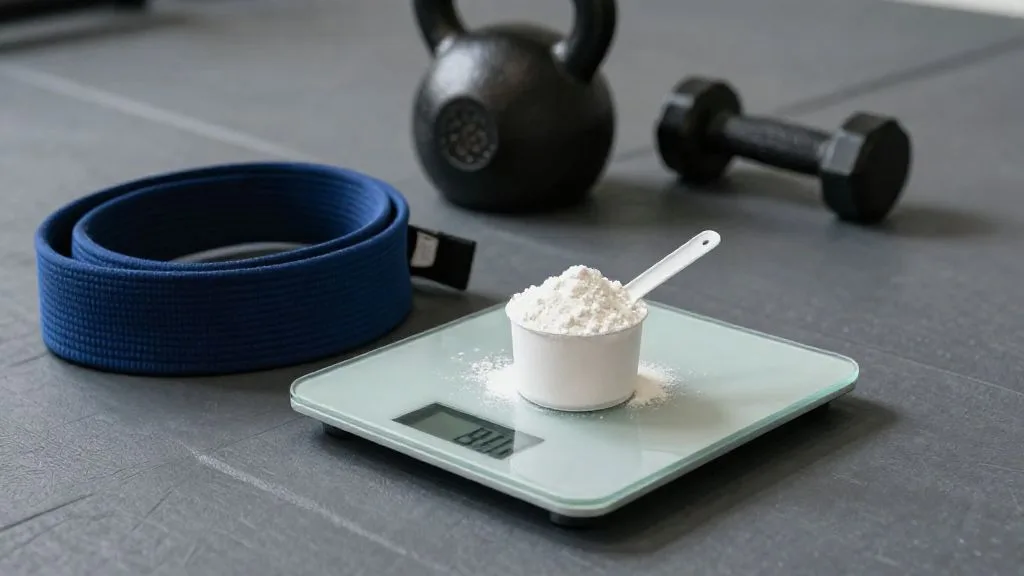
The short answer is fairly clear: 3 to 5 grams a day can help grapplers, especially in repeated high-output efforts, and it usually does not ruin a sensible weight cut. But it can make scale management tighter for athletes who already walk around too close to their class limit or rely on aggressive last-week dehydration.
That trade-off matters more in judo than in most BJJ settings, because same-day or tighter weigh-in structures punish sloppy cuts harder than the IBJJF-style routine where athletes sometimes have a little more room to manage. The supplement is not the problem by itself. Bad planning is.
Why creatine matters more in grappling than people give it credit for
BJJ and judo are not pure endurance sports. A match has long low-intensity stretches, but the moments that decide it are usually short and violent - a grip-fight surge, a stand-up exchange, a scramble off a failed guard pass, a burst to finish a single leg, a bridge-and-turn to escape side control.
Those efforts lean heavily on the phosphocreatine system. That is exactly where creatine supplementation helps.
Creatine monohydrate raises intramuscular phosphocreatine stores. In practical terms, that can support repeated explosive efforts and help maintain output across multiple rounds, live goes, or tournament matches in the same day. It does not magically turn a tired grappler into a fresh one. It helps the drop-off come later.
That tends to matter in training even more than competition. In a hard six-round session, the athlete on adequate creatine often keeps a little more pop in rounds four, five, and six. Not dramatic. Just enough to finish shots cleaner, hold posture better, and stop looking flat during the last scramble.
And for strength work outside the mat room, the evidence is even less controversial. Better training quality in repeated lifts and short efforts can support more useful strength and power over time. For grapplers, that means the benefit is partly direct and partly indirect.
Will 3 to 5 grams a day make you heavier?
Usually, yes. But the type of weight matters.
Creatine tends to increase intracellular water, meaning water stored inside muscle cells rather than random bloating under the skin. A common early increase is roughly 0.5 to 1.5 kg over the first days or weeks, though the exact amount varies a lot. Bigger athletes with more muscle sometimes notice more. Smaller athletes, lighter women, and athletes already eating a high-meat diet may notice less.
This is where combat athletes get stuck. They hear "water retention" and picture a soft, puffy body that feels slow and heavy. That is not usually what happens with 3 to 5 g/day of creatine monohydrate. Most of the time, the athlete just weighs a bit more and performs a bit better.
The scale change is real, though. If an athlete walks around at 81.8 kg for an 81 kg class and always cuts the last 1 kg with stress, sodium manipulation, and a hot bath, creatine may be enough to make that routine uglier.
So the answer depends less on the supplement itself and more on how badly the weight class was already being managed.
Creatine for BJJ and judo during a weight cut
For athletes with a proper runway, creatine for BJJ and judo can stay in during a cut. "Proper runway" means bodyweight is trending down weeks ahead of the event, not days. If 3 to 5 grams daily adds a little scale weight but helps preserve training quality, that can actually make the cut easier to execute because sparring and lifting do not fall apart so early.
Where it becomes risky is a short-notice cut, or any camp built around being heavy until the final week. In that setup, even a modest increase in total body water can narrow the margin for error. Judo athletes especially should respect this, because weigh-in timing and same-day performance can punish aggressive dehydration more than people expect.
A practical split looks like this:
- Good candidate to keep creatine in: athlete is 2 to 4 percent above class several weeks out, loses weight gradually, and values hard training quality through camp.
- Borderline candidate: athlete is close to the class limit but still cuts late and inconsistently.
- Bad candidate to keep creatine in: athlete is routinely too heavy, depends on last-minute water cuts, or has same-day competition demands where every extra 0.5 kg becomes a problem.
There is no heroism in forcing a supplement into a plan that is already hanging by a thread.
Loading phase or steady dose?
For grapplers worried about scale weight, skip the loading phase.
The classic loading protocol is around 20 g/day for 5 to 7 days, usually split into four doses. It saturates muscle stores faster, but it also tends to bring a sharper early rise in body mass. That is fine for off-season strength blocks. It is less useful for athletes who track every fraction of a kilo.
A steady 3 to 5 g/day of creatine monohydrate gets to the same place more gradually. It is slower, but cleaner. Fewer athletes complain about stomach upset, and the bodyweight change is usually easier to monitor.
For BJJ and judo, that slower approach fits the calendar better anyway. Most athletes are not trying to peak in seven days. They are trying to train well for months.
What creatine actually helps on the mat
Not cardio in the way roadwork people mean cardio.
Creatine is more useful for repeated explosive actions and maintaining quality across hard efforts than for improving steady aerobic output. On the mat, that can look like:
- stronger repeated grip exchanges during stand-up rounds
- better shot reshoots after the first attack stalls
- less drop in power during positional sparring with short rest periods
- more stable strength in tournament settings with several matches
- slightly better support for strength training and sprint intervals off the mat
One common training-room pattern is simple: the athlete does not become more technical, but late-round sloppiness arrives a bit later. In judo, that may show up as less dead pull on the sleeve and lapel in the last exchange. In BJJ, it can mean the second stand-up from bottom still has intent behind it instead of turning into survival mode.
That is not a small thing.
Creatine for BJJ and judo is not equally useful for every athlete
A heavyweight training for no-gi superfights and a lightweight judoka trying to hit a strict class on same-day timing are not dealing with the same problem.
Creatine tends to make the most sense for grapplers who need more repeat power, train hard enough to benefit from it, and have enough margin above weigh-in stress to absorb small shifts in water weight. That includes plenty of advanced hobbyists, off-season competitors, and athletes moving up a division on purpose.
It makes less sense for chronically undersized athletes forcing a lower class, especially if they already get flat, crampy, and mentally cooked from the cut itself. In that case, the cleanest move is often more basic: choose the right class, tighten nutrition, and stop pretending the last 48 hours can fix a bad camp.
There is also the non-responder issue. Not everyone notices much. Athletes with naturally higher baseline muscle creatine stores may feel very little from supplementation. If bodyweight goes up and mat performance does not, that is useful information, not failure.
How to use it without making the scale unpredictable
Consistency matters more than tricks.
Take 3 to 5 g/day of creatine monohydrate, ideally the same time each day, and track morning bodyweight for at least 2 to 3 weeks before making any judgment. Do not start creatine ten days before a tournament and then blame it for a scale surprise that was really poor timing.
For athletes who compete regularly, the least messy system is often this:
- use creatine consistently in general training
- monitor how much bodyweight rises after 14 to 21 days
- decide well ahead of camp whether the current class still makes sense
- if the cut is going to be very tight, remove creatine early enough to observe how bodyweight settles rather than guessing during fight week
Also, use plain creatine monohydrate. Kre-Alkalyn and buffered blends have marketing behind them, not a better case for combat sports performance. Monohydrate is the version with the strongest evidence and the lowest cost.
Does creatine cause bloating, cramps, or bad gas tanks?
Usually not in the dramatic way gym lore describes.
Stomach issues can happen, especially with large doses or poor mixing, which is another reason the no-loading route suits grapplers better. Cramps and dehydration fears have been overstated for years. In normal use, creatine is not the thing wrecking a gas tank during rounds. Bad pacing, low aerobic base, poor sleep, and an ugly weight cut do that far more reliably.
If an athlete suddenly feels awful after starting it, the first checks should be dose, hydration habits, and timing around training, not superstition.
Should you stop creatine before competition?
Only if the class is tight enough to justify it.
If the athlete comfortably makes weight and competes better with higher training output, there is little reason to pull it. If the athlete is squeezing into a division and every bit of retained water matters, stopping 1 to 3 weeks out can make sense, but only after testing that response in advance. Doing it blindly before a major event is amateur stuff.
For no-gi tournaments with multiple same-day matches and less punishing weigh-in stress, staying on creatine is often the better performance choice. For judo players on stricter margins, caution is more justified.
Should BJJ and judo athletes take creatine every day?
Yes. Daily use works better than only taking it on training days because muscle saturation matters more than acute timing.
Is 5 grams better than 3 grams for grapplers?
Sometimes, but not always. Larger athletes often use 5 g/day comfortably. Smaller athletes may do fine on 3 g/day. The difference is usually not dramatic enough to justify guessing - track bodyweight and performance.
Will creatine ruin a same-day judo weigh-in?
It can if the athlete already runs too close to the class limit. It usually does not if weight is managed early and the class is realistic.
Do you need a loading phase before a tournament?
No. For weight-class athletes, loading is often the worse option because it raises body mass faster and offers no special advantage once full saturation is reached later through steady daily use.
What form of creatine is best for BJJ and judo?
Creatine monohydrate. It is the standard used in most sports nutrition research, including repeated sprint and strength studies relevant to grappling.
If making weight already feels like a coin flip, creatine is not the supplement to blame - the weight class is.