There are really two samurai in the popular imagination. One is the calm, death-ready warrior who lives by an iron code. The other is the political retainer, tax collector, opportunist, and survivor shaped by messy civil war. The second man is usually closer to the historical record.
Bushido, as most people describe it now, was built more by peace than by war. That is the part that changes the whole discussion. If you picture armored fighters in the Sengoku period, from roughly 1467 to 1600, making battlefield choices by reciting a fixed ethical manual, you are already looking at the Edo period backward. A lot of what later became "the way of the warrior" was written down, polished, and moralized after Tokugawa Ieyasu had largely ended the age of constant large-scale conflict.
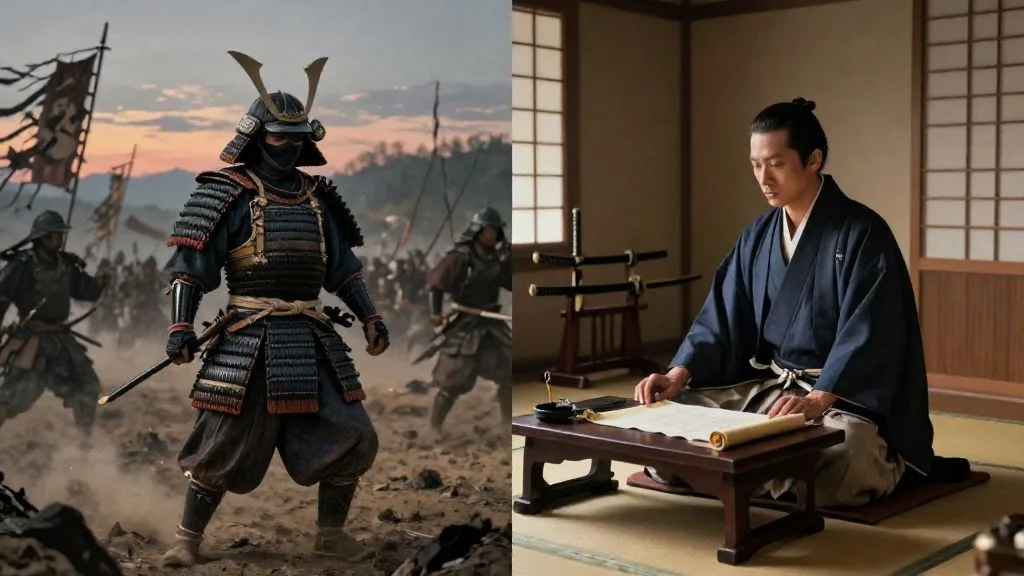
So did samurai actually live by bushido? Not in the clean, unified sense people mean today. They lived by lordship, clan obligation, self-interest, reputation, Buddhist and Confucian influence, local custom, and the demands of surviving the next campaign. Bushido came later as a way of explaining, disciplining, and idealizing that class.
Edo peace gave bushido its finished shape
Once the Tokugawa shogunate settled in after 1603, samurai did not disappear. But their daily role changed hard. Fewer battlefields. More administration. More bureaucracy. More need to justify why a hereditary warrior class should still sit above farmers, artisans, and merchants during long stretches of peace.
That setting matters. A code becomes more attractive when the original conditions that produced the class are fading. Writers in the Edo period could systematize virtues like loyalty, frugality, rectitude, and readiness for death because samurai identity needed a moral framework, not just a military function.
Yamaga Soko is a useful example. In the 17th century, he argued that the samurai should serve as moral exemplars for society. That is already different from the image of a battlefield professional improvising under arrow fire. Later texts like Hagakure, associated with Yamamoto Tsunetomo in the early 18th century, pushed the death-embracing ideal even further. Powerful writing, yes. But it came from a retired world, not a campaign tent before Sekigahara.
And Nitobe Inazo, writing Bushido: The Soul of Japan in 1900, helped export an even smoother version to foreign readers. By that point bushido was not just ethics. It was national branding.
Battlefield samurai were not philosophers first
On campaign, practical incentives usually beat abstract virtue.
During the Sengoku period, alliances shifted constantly. Daimyo changed sides. Vassals defected. Castles surrendered to avoid annihilation. Heads were taken for identification and reward. Firearms after Tanegashima in 1543 changed tactics. None of that looks like a stable, universally obeyed moral code.
Look at the careers of Oda Nobunaga, Toyotomi Hideyoshi, and Tokugawa Ieyasu. These were not men operating inside a soft-focus legend. Nobunaga used ruthless force, including the destruction of Enryaku-ji in 1571. Hideyoshi rose from low birth through talent, politics, and military service, which alone should warn you against simplistic hereditary ideals. Ieyasu survived by patience, hostage politics, strategic retreat, and timing. Survival first. Principle after, if possible.
Even loyalty, the virtue most closely tied to bushido, was conditional more often than schoolbook versions admit. A retainer owed service, yes, but lords also owed protection and reward. If a lord failed badly, movement between houses was not unheard of. The 16th century was full of military labor markets disguised as honor cultures.
That does not mean samurai had no values. It means those values lived inside war, rank, and material stakes. Rice stipends mattered. Land mattered. Hostages mattered. Family continuity mattered. A dead "ideal" warrior is still dead.
What later writers turned into timeless virtues often began as control mechanisms
This is where martial artists usually perk up, because it feels familiar. Once a fighting system moves away from constant testing, language around discipline and spirit tends to expand. Sometimes that is healthy. Sometimes it becomes decorative.
Edo bushido often worked as class discipline. If you are a samurai in peacetime, carrying two swords but spending your week on paperwork, debt, ceremonial duties, and domain administration, you need an ethic that tells you your role still has meaning. Neo-Confucian thought helped with that. So did teachings on self-restraint, hierarchy, and service.
The trade-off is obvious. The cleaner the ideal becomes, the less it resembles wartime behavior.
Hagakure is famous for the line about the way of the warrior being found in death. People quote it like a field manual. It was not. Tsunetomo wrote from a position shaped by peace and by frustration with changing samurai life. It reflects a mood, an ethic, even a protest against bureaucratic dilution. It does not describe the full range of actual decisions made by mounted archers, ashigaru commanders, or castle defenders in the 1500s.
The famous cases do not prove a universal code
The 47 Ronin are probably the most cited example of bushido in action. Their revenge in 1702 became cultural shorthand for loyalty and sacrifice. But even that story shows the problem. The event mattered so much precisely because it was dramatic, debatable, and morally charged. Authorities punished the ronin through ordered seppuku rather than celebrating them without reservation.
If bushido had been a simple lived consensus, the case would not have so much argument in the first place.
Seppuku itself is another area where myth outruns context. Ritual suicide did exist, and it had real political and social meaning. But it was not a constant everyday expression of pure warrior ethics. It could function as punishment, protest, preservation of status, or compelled performance. Romantic retellings flatten those distinctions.
The same goes for dueling culture. Miyamoto Musashi is often folded into bushido mythology, yet Musashi's own Book of Five Rings is far more concerned with strategy, timing, deception, rhythm, and practical superiority than with moral sermonizing. He reads like someone who expected conflict to be won by clear perception and ruthless efficiency.
What this changes for how martial artists read samurai philosophy
If you train long enough, you start to notice a gap between codes people recite and habits they actually keep. A dojo says discipline matters. Then you watch who cleans their gear, who shows up on time, who manages fear honestly in sparring, who protects training partners, who chases status. Real ethics are usually behavioral, not ceremonial.
Samurai history works the same way. Bushido is useful if you treat it as a later ethical interpretation of the warrior class, not as a live audio feed from medieval battlefields. It can still offer something. Seriousness. Duty. Self-command. Acceptance of consequence. But once you mistake the idealized text for the lived reality, you stop seeing the human being carrying the sword.
And the human being is the whole story.
He could be brave and calculating. Loyal and ambitious. Cultured and violent. Capable of poetry one season and opportunistic betrayal the next. That contradiction is not a flaw in the record. It is the record.
I've noticed students often understand this fastest through training, not books. Watch how somebody behaves in a hard round after they get clipped, and you learn more than you do from ten speeches about warrior spirit. A good practical tip is to read Hagakure next to Book of Five Rings, then ask which one sounds like peacetime identity-making and which one sounds like someone expecting consequences by sunset.